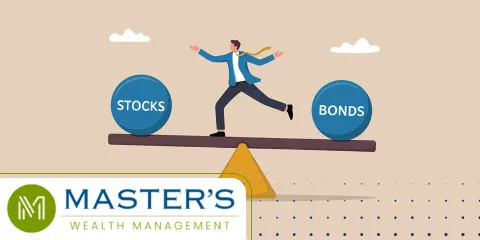
At Master’s, during the second quarter of each year, we take a deeper dive into evaluating our clients’ investment portfolios. During these investment review meetings, one question has come up frequently lately: “Why do we own bonds in our portfolios?”
That question feels especially relevant right now when the S&P 500 Index is up nearly 10% year-to-date while many bond funds are down 1–2%. In periods like this, it can be easy to question the role bonds play in a diversified portfolio.
In today’s blog, we’ll discuss the primary purpose of bonds and bond ladders, upsides and downsides of using them in your portfolio, and address some of the most common questions we get around them.
Let’s get started.
Bond Overview
For us, the answer to why bonds are an important part of a sound strategy is straightforward and rooted in Master’s investment philosophy: bonds serve one primary purpose — to help buffer stock market volatility.
In recent years, many investors have lost sight of that role because bonds have provided little visible benefit. In fact, for nearly five years, stocks have largely outperformed while bonds have faced the headwinds of rising interest rates. When one asset class consistently lags another, it’s natural to begin discounting its value.
However, diversification tends to prove its worth most during periods of uncertainty and market stress — not during strong equity rallies.
We strongly believe that your personal goals should drive your investment allocation. The longer your time horizon before needing investment assets to fund those goals, the greater your allocation to stocks can generally be.
Conversely, the sooner you’ll need to rely on your investments for income or withdrawals, the more important bonds become in helping provide stability, predictability, and a smoother investment experience.
How to Incorporate Bonds Into Your Portfolio
Another question we regularly address is: “What is the best way to gain bond exposure?”
For many investors, using professionally managed bond mutual funds or exchange-traded funds (ETFs) is an efficient and practical solution. Bond funds provide broad diversification, professional management, and easy access to many different segments of the fixed income market.
Understanding Bond Risks & Downsides
However, bond funds also come with some drawbacks.
First, every fund carries management expenses. These costs can range from as little as 0.05% annually for low-cost index funds to 0.50% or more for actively managed strategies. Second, during periods of rising interest rates, declines in bond fund values can sometimes be amplified when other investors sell their shares during periods of market stress.
One advantage of working with a diverse custodial partner like Raymond James is access to a highly developed fixed income platform. Raymond James maintains a robust bond department that both trades bonds efficiently and originates new bond issues. For clients with larger bond allocations — typically $500,000 or more — this allows us to build customized bond ladders.
The Benefits of Bond Ladders for Large Portfolios
A bond ladder is a portfolio of individual bonds with staggered maturity dates.
Instead of owning one bond that matures at a single point in time, investors own multiple bonds that mature over a series of years. As bonds mature, the proceeds can either be used for spending needs or reinvested into new bonds at prevailing interest rates.
There are several benefits to owning a bond ladder:
- Predictable cash flow: Because bonds mature at different intervals, investors can better match future cash needs with upcoming bond maturities.
- Reduced interest rate risk: A ladder helps smooth the impact of rising interest rates since only a portion of the portfolio matures at any given time and can be reinvested at higher yields.
- Greater control and transparency: Investors know the maturity date, interest payments, and principal value of each individual bond held.
- Lower emotional pressure during market volatility: Unlike bond funds, individual bonds held to maturity will generally return their principal value assuming no default, which can provide peace of mind during periods of market stress.
- Potential cost efficiency: For larger portfolios, individual bonds may reduce ongoing management expenses associated with mutual funds or ETFs.
The Bottom Line on Bonds
Ultimately, bonds are not designed to outperform stocks over long periods of time.
Their purpose is to provide stability, preserve capital, and help investors stay disciplined through varying market environments. A well-structured bond allocation can help create confidence and flexibility, especially during periods when markets become more volatile or uncertain.
At Master’s, we believe successful investing is not about chasing the best-performing asset class each year. It’s about building a thoughtful portfolio aligned with your goals, risk tolerance, and time horizon — and maintaining the discipline to stay invested through all market cycles.
If you have questions about your bond allocation, bond funds, or whether a customized bond ladder may be appropriate for your portfolio, we’d welcome the opportunity to discuss how fixed income can support your long-term financial goals. Contact us today.